Buying property in Dubai can be attractive for investors, but the purchase price alone does not tell you whether a property is a good investment. To understand the potential return, investors should look at Dubai property ROI, rental yield, ongoing costs, rental demand and potential capital appreciation.
A property with a lower purchase price is not automatically a better investment. The right property is one where the expected rental income and long-term value make sense after considering the costs involved.
What Is Dubai Property ROI?
Dubai property ROI refers to the return an investor expects to receive from a property compared with the amount invested.
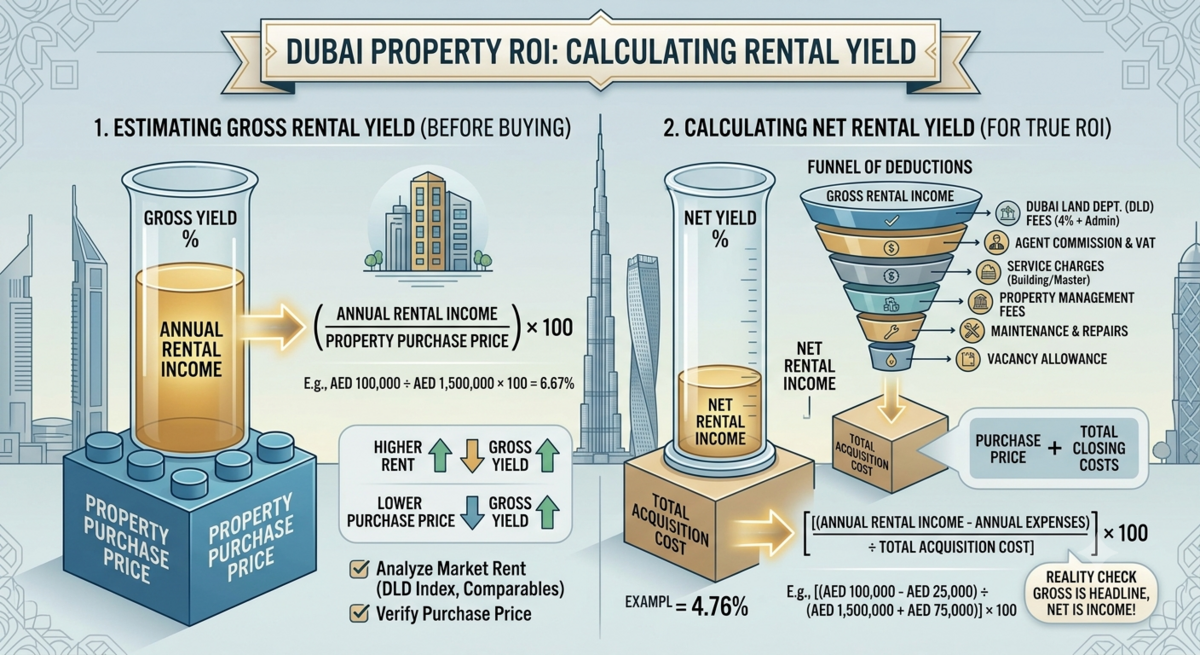
For a rental property, investors commonly look at rental yield, which compares the annual rental income with the property's purchase price.
A simple calculation is:
Gross Rental Yield = (Annual Rental Income ÷ Property Purchase Price) × 100
For example, if you purchase an apartment for AED 1,000,000 and receive AED 70,000 in annual rent:
AED 70,000 ÷ AED 1,000,000 × 100 = 7% gross rental yield
However, this is only a starting point. Your actual return can be lower after service charges, maintenance, management fees, vacancy periods and other expenses.
How Do You Calculate Rental Yield in Dubai?
To estimate the rental yield of a Dubai property, follow these steps:
1. Find the Total Purchase Price
Start with the property's agreed purchase price.
For example:
- Property price: AED 1,000,000
- Annual rent: AED 70,000
The purchase price forms the base for calculating the gross rental yield.
2. Estimate Annual Rental Income
Check realistic rental prices for comparable properties in the same community.
Consider:
- Property size
- Number of bedrooms
- Furnishing
- Building quality
- Location
- Amenities
- Parking
- Metro or transport access
- Current tenant demand
Do not base your calculation only on the highest advertised rent. Look for comparable properties and realistic achievable rent.
3. Calculate Gross Rental Yield
Using the example above:
AED 70,000 ÷ AED 1,000,000 × 100 = 7%
So, the property's estimated gross rental yield is 7%.
4. Deduct Property Expenses
Gross rental yield does not represent the investor's final return.
You may need to account for:
- Service charges
- Property management fees
- Maintenance
- Repairs
- Insurance
- Vacancy periods
- Leasing costs
- Mortgage interest, if applicable
- Other property-related expenses
This gives you a more realistic picture of the investment.
Example: Calculating ROI on a Dubai Apartment
Suppose an investor purchases a one-bedroom apartment for AED 1,000,000.
The expected annual rent is AED 70,000.
The gross rental yield is:
AED 70,000 ÷ AED 1,000,000 × 100 = 7%
Now assume the investor has AED 12,000 in annual property-related expenses.
The estimated net rental income becomes:
AED 70,000 − AED 12,000 = AED 58,000
The simplified net rental yield would therefore be:
AED 58,000 ÷ AED 1,000,000 × 100 = 5.8%
This illustrates why investors should look beyond advertised rental yields when comparing Dubai properties.
What Costs Should You Include When Calculating Dubai Property ROI?
A proper investment calculation should include both initial purchase costs and ongoing property expenses.
Dubai Land Department's current property sale registration information lists a 2% sale registration fee for the buyer and 2% for the seller, along with additional title deed, map and service-related charges.
Depending on the property and transaction, an investor may also need to consider:
- Dubai Land Department registration costs
- Title deed and map charges
- Real estate agency fees
- Mortgage-related costs
- Property management fees
- Annual service charges
- Maintenance and repairs
- Furnishing costs
- Vacancy periods
- Leasing or tenant-related expenses
Including these costs gives you a more realistic estimate of your total investment and expected return.
Which Dubai Areas Can Offer Strong Rental Demand?
Rental performance can vary significantly betweenDubai communities.
Areas with strong tenant demand can be attractive because a property that remains occupied consistently may produce more reliable rental income.
Current 2026 market guides identify communities such as Dubai Silicon Oasis, International City, Dubai Sports City, Al Warsan and Jumeirah Village Circle (JVC) among areas being considered for rental-property investment.
However, there is no single “best” area for every investor.
A high-yield area may have different levels of:
- Capital appreciation potential
- Tenant demand
- Property prices
- Service charges
- New property supply
- Liquidity
- Vacancy risk
The right choice depends on whether your priority is rental income, long-term appreciation, affordability or a combination of these factors.
Rental Yield vs Capital Appreciation
Rental income is only one part of Dubai property investment.
Rental Yield
Rental yield measures the income generated from renting out the property.
It is particularly important for investors looking for regular cash flow.
Capital Appreciation
Capital appreciation refers to an increase in the property's market value over time.
For example, if you purchase a property for AED 1 million and its value later reaches AED 1.15 million, the property has experienced AED 150,000 in capital appreciation.
However, appreciation is not guaranteed.
A good investment analysis should therefore consider both potential rental income and the property's long-term market fundamentals rather than assuming prices will always increase.
What Should Indian and Nepali Investors Consider?
Investors from India, Nepal and other international markets should evaluate a Dubai property based on numbers rather than simply choosing a popular location.
Before purchasing, consider:
- Total investment required
- Expected annual rental income
- Gross and estimated net rental yield
- Service charges
- Property management costs
- Expected vacancy
- Financing or mortgage costs
- Potential resale demand
- Location and infrastructure
- Long-term investment objective
International buyers should also understand the ownership rules, transaction process and financing requirements applicable to their situation.
Is Dubai Property a Good Investment for Rental Income?
Dubai property can provide rental income opportunities, but the outcome depends on the individual property.
A strong investment case usually requires more than simply finding a property with a high advertised yield.
Look at:
Purchase price + rental income + expenses + tenant demand + vacancy risk + potential appreciation
The Dubai rental market is also not uniform. Current 2026 market reporting indicates that some apartment-heavy areas are experiencing more adjustment as new supply enters the market, while established villa and waterfront communities have shown comparatively stronger stability.
That makes property-level analysis increasingly important.
Simple Checklist Before Buying an Investment Property in Dubai
Before making a decision, ask:
- What is the actual purchase price?
- What rent can the property realistically achieve?
- What is the gross rental yield?
- What are the annual service charges?
- How much will maintenance cost?
- Could the property remain vacant between tenants?
- Are there significant upcoming developments nearby?
- Is the area attracting tenants?
- What is the resale demand?
- Am I investing for rental income, capital growth or both?
If the numbers still make sense after accounting for these factors, the property may deserve further consideration.
Frequently Asked Questions
What is a good rental yield in Dubai?
There is no universal rental yield that makes a property a good investment. Investors should compare the expected yield with the property's purchase price, expenses, vacancy risk, location and potential for capital appreciation.
How is Dubai rental yield calculated?
Divide the expected annual rental income by the property's purchase price and multiply by 100 to calculate gross rental yield.
Is gross rental yield the same as ROI?
No. Gross rental yield only considers rental income against the purchase price. ROI can include additional investment costs, expenses and potential capital gains.
Which Dubai areas are good for rental property investment?
The answer depends on the investor's budget and objective. Areas with strong tenant demand can offer rental opportunities, but investors should compare purchase prices, rental income, service charges and supply before choosing a community.
Should I consider rental income or capital appreciation?
Ideally, consider both. Rental income can provide ongoing cash flow, while capital appreciation may contribute to the property's long-term investment return.
Are Dubai property returns guaranteed?
No. Rental income, property values and investment returns can change with market conditions, supply, demand and individual property performance.
Final Thoughts
Dubai property ROI should be calculated using the complete investment picture, not just the advertised rental yield.
Before buying, compare the purchase price with realistic rental income, deduct ongoing expenses and consider tenant demand, vacancy risk and potential capital appreciation.
For international investors, especially those buying from India or Nepal, understanding the numbers before choosing a community can help make the Dubai property investment process more informed and structured.
Lyka Realty is a trusted Dubai real estate agency helping clients buy, rent, and lease residential and commercial properties. We provide personalized property solutions across Dubai's prime communities with professional guidance, transparency, and local market expertise.